
Is the BMW i3 REx the ideal city car of the future, available today?
Is the BMW i3 REx the ideal city car of the future, available today?


When an innovative team of people at BMW agreed to start designing the ideal city car, they were given the go-ahead to start on a blank canvas. This will be a BMW unlike any other – in fact it will not be a BMW, but a car under the BMWi sub-brand.
BMWi sub-brand
So different is the BMW i3 city car and the BMW i8 supercar that they warranted receiving their own sub-brand. To design cars that will be not just innovative and modern like BMWs are, but which push the envelope into futuristic design, and use full or partial electric drivetrains.
These new BMWi cars do not fit into the carefully arranged line-up of BMW 1 through 7 Series or M, X or Z cars. So different, they will have to stand apart on their own. This is how the BMWi sub-brand was born.
Unlike anything else on the road, the BMW i3 is a head-turner, and major talking point – be ready to be bombarded with many questions, and requests to look inside or under the “bonnet”.
Its BMWi electric blue grille, space-ship shape, huge wheels on skinny tyres, rear black-glass integrated taillights in a smiley-face make this one distinctive car.
The e in eDrive is for electric efficiency, and surprising energy
All BMWi cars use electric drive for efficiency. Rather than a conventional internal combustion engine only, the electric drivetrain is the main source of motive power in the BMW i3. There are 2 models: a BMW i3 BEV which is fully electric, and the BMW i3 REx, which stands for Range Extender (no, not Rex meaning king). The i3 REx is the car reviewed here. The BMW i8 electric supercar uses a combination of a serious electric motor and, when called on, a 3-cylinder turbo engine.
But back to the BMW i3 REx on test here. How efficient is it really? Well, having driven it extensively and eagerly around town, up the mountain hill a few times, to meetings, to school, to the shops and all over, the battery lasted for 2 days of driving. This was done deliberately to test how long it will last.
Well this might be BMWi, but is still a form of BMW, so clearly this would not be a slow car. If you have experienced the instant quiet lift-off in an electric golf cart or electric bike, you will know the feeling. Except, in the BMW i3 REx, you sit up high in a car, yet still get the same sprinter speed, scooting away from the stop or traffic lights intersection… without any engine noise! People look at the i3 and dismiss it as a weird over-eco car, until you put your foot down. It jumps away from the line, seeing off most hot hatches and many sports cars, as it whisks away, silently – no mess, no fuss.
Only a pleasant zweeeee whistle heard from the electric motor (possibly just as you would imagine an electric car would sound like). BMW claims 0-100 km/h in 7.9 seconds, but this figure is misleadingly slow, as the take-off acceleration to 60 and 80km/h is properly strong. The energy is surprising.
Everyone asks “Can you drive long distance?”
Yes, you can. But this has to be said convincingly, and you can see the doubt in the eyes of the one who asked the question (as if the expected answer was no, you cannot) and wants more reassurance from the one who gives the answer. BMWi claims a range of between 120 and 340km on a full charge and full 9-litre fuel tank. Yes, 9 nine. From a fully-charged battery, expect a range in town, even when driven in haste with no regard for or fear of the battery going flat, of 150km, on battery power alone… and if it runs out, the generator simply kicks in to keep you going (see section below for more on this). If driven carefully, you can easily extend this to 200km or more, on battery.
The tablet-style upright instrument panel also keeps you constantly updated through 2 “fuel” gauges – on the left it shows the driving range on the petrol tank (for the generator) and on the right is the battery life bar.
The 9-litre tank may sound very small, but its petrol is only needed to run the generator, which is where the claimed 0.6 litres per 100km comes in.
A little automatic generator in under the boot floor keeps you going
The idea of installing an electric motor is good, but has its limitations. Whereas the BMW i3 BEV uses only electric power, and when the battery runs out you have to recharge – this works well in advanced European cities where you can stop at many places and plug in your car to recharge. The best bet for local drives, due to a lack of charging infrastructure at this stage, is the BMW i3 REx with its Range Extender, which is a tiny 2-cylinder engine mounted in the back, as a generator which does not drive the car, but simply generates electricity to power the battery, to keep giving electric drive. Ingenious!
The generator kicks in seamlessly, and will do so when the battery is nearly empty, switching in and out. When the battery power runs out, the generator will again start up and keep running, to keep you going. It sounds exactly like a little generator, but compared to the hushed silence of the electric eDrive, one feels a bit self-conscious. An incentive to keep the batteries charged, and to drive more smartly. More on smart driving below.
How long does it take to recharge the BMW i3, and can I charge it at home?
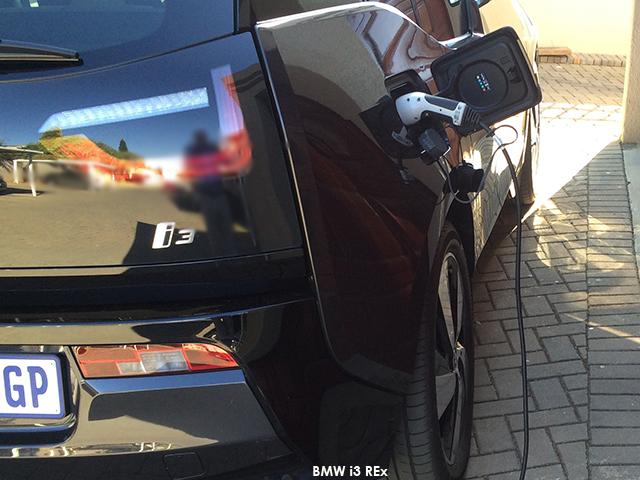
The BMW i3 comes equipped with 2 cables in the front boot (there is no engine in front). The 1 cable is for home-charging, which you simply plug into your standard 3-point plug in your garage or nearest plug at home or at the office parking. Simple. When plugging in the car to recharge (an action quite strange at first) the blue square around the plug glows to show it is being charged. The other cable is for when you have the charging station installed at home or office, which is quicker to charge than the abovementioned 3-point plug. This installation is done by a company – they will come out to your place to quote and do a professional installation.
The instrument display will confirm the car is connected to the mains by displaying a blue power cord and plug icon. It will show you how much driving distance you have left on the current charge, and an estimated time of how long it will take to recharge to 100% battery power. It very cleverly shows you how long it will take to recharge to achieve what range. For example, the display indicated 3:02 (3 hours 2 minutes) to recharge to a range of 102km.
You would want to know the status of the car’s charge, when it is being recharged and when it is locked, right? When touching the door handle, the instrument display will light up and show the charge status. You can also download the BMWi Remote app on your smartphone, which will let you pair it to your BMWi car so you can see your car’s status on your phone.
As a test, the car was charged for a quick 30-minute top-up, which gave some extra range to reach a nearby destination, but is best left to charge overnight – just as you are already used to doing with electronic devices such as your phone, tablet, or laptop.
A visual telltale to distinguish the all-electric BMW i3 BEV from the BMW i3 REx is the REx’s fuel filler flap (which BEV doesn’t need) on the right front fender.
One-pedal driving joy
Nice is the recharging as you drive – not only nice for converting the kinetic (movement) energy back into the power and topping up the battery as you drive (which we have seen on hybrids – but on the BMW i3 it is much stronger) but also nice as you can simply lift off the accelerator and it will brake itself. Yes, the lift-off recharge is so strong it does the braking for you. It takes some getting used to, requiring an adapted driving style. You can literally drive all day without touching the brake pedal. You are rewarded for topping up by a space-ship sounding downward eee-ooo-www sound.
But what about the brakes activating when there are cars behind you? Don’t worry, the clever Germans thought of everything – when you lift off the throttle to engage regenerative braking, the brake lights come on.
Being a more eco-responsible and less sporty BMW i3, this car has no Sport mode – just Comfort, Eco Pro and Eco Pro+ (which lets you drive in battery-saving mode with the climate control off, and to a limited top speed).
Practice to drive more smartly – learn to leave the throttle pedal completely (not just partially), coast downhill, and learn to time your deceleration approach to traffic ahead, a stop street or red traffic light, which means you let the brakes recharge the battery. It is like a computer game for the road.
You can drive all day (after practice and with safe care!) using only the throttle pedal. A side benefit, especially for your urban mobility, is the comfort of regulating speed using only your throttle pedal – no need to move your foot between pedals. One-pedal driving joy.
How should the ideal city car of the future be?
Don’t think of this as a conventional BMW. Think of this as BMW’s way to think into the future and build the ideal ultra-modern (even futuristic) city car as the BMW i3, and the ideal first-ever eco-conscious supercar in the BMW i8.
The ideal city car of the future should be very easy to drive. The BMW i3 is, very. It should be spacious inside, without any clutter in the centre console, and the instrument layout should be neat. Inside the BMW i3 you will see how this was achieved, with a spacious clean layout, like it comes straight out of a spaceship (but without any overwhelming mock switches and lights).
Comfortable? Of course yes. The getting in and out, the seats, the steering, the human drive experience, all-round visibility, low noise and smoothness – all make up a comfortable BMW i3.
On the highway, the feeling of travelling at 120km/h on battery power is surreal. It is super quiet in here, with only very faint sounds from tyres and wind.
To have easy access and look stylish, you don’t want 4 doors – you need 2 big doors in front, and 1 side rear-ward opening side door (like the MINI Clubman small side door) which will let your occasional passengers slide into the rear. The BMW i3 is a cross-over if ever there was one – it is high hatchback yet MPV-ish high, and SUV-like square… yet with 2+1 side doors. A hatch/MPV/SUV/coupe… cross-over.
Someone who actually drives in urban areas a lot clearly designed the inner door handles and the easy-opening wide-gap doors – rather than positioned at the top of the door panel and horizontally as in most cars (which is not a natural ergonomic hand movement) the BMW i3 door handles are placed ahead of the door armrests, and are angled at 45 degrees which makes it a natural slide of the fingers to open – thank you! The doors are huge, opening up a wide gap to simply walk into or dismount from – not too long, which is a common problem on 2-door cars, but fairly short, making it easy to open when parked alongside other cars or a wall. Simply pop your hand around the edge of the driver’s side rear door, and it flips open backwards, making it easier to move or un/load people or items from into/from the rear seat.
Materials used to manufacture the car should be recycled and earth-friendly – yes, the doors and dashboard use a strange-looking compressed felt-like rough surface material, and carbon fibre is bare to show what it is constructed from. All very unusual, and properly different to any other car. The buyer can choose from modern themes, grouping colours and materials and woods, appropriately named Atelier (studio), Loft, Lodge or Suite. The test car had the BMWi interior design Loft, which is a mix of ivory-whites, beiges and some light and dark greys – all very airy, monotone and minimalist as you would find in most loft apartments. The light coloured carpets looked great when new, but became soiled very soon, even with care taken to wipe shoes where possible. Perhaps choose a more practical colour.
A city car should be easy to see out of, but be short enough to park easily into and out of smaller parallel city spaces (here the park assist automated parking comes in handy). It must have automatic gearshifts – the BMW i3 uses an unusual big stalk to twist into gear: yes, there is no gear selector as found on the centre console in BMWs, but a big steering-column mounted pod which rotates, assisted by a thumb lever to ease the tilting action, as you tilt it forwards for D and back for R.
How much is it?
The BMW i3 does not have any direct rivals, as it is so totally unique. The only other fully-electric car on the market is the Nissan Leaf, which is an odd-shaped hatch, costing just on R 500 000. The BMW i3 BEV is also electric, priced at R 532 500.
What would you pay for the new BMW X1 xDrive25i, a 328i GT, 330d, or X3 xDrive20d – these normal everyday BMWs? Around R 600 000. Therefore, the BMW i3 REx, with its futuristic design for drivetrain, body and interior, is not more expensive than a normal everyday BMW, but priced on par, at R 602 500. Except, you save on not having to fill up a costly tank of fuel every few-hundred kilometres.
Is the BMW i3 REx the ideal city car of the future, available today?
BMW thought so far outside the box and pushing way outside the edge of the car envelope in creating the ideal city car of the future… yet… it is available today.