
Audi RS 3 and TT RS: Five-cylinder monsters
Audi RS 3 and TT RS: Five-cylinder monsters



By Martin Pretorius
Audi has produced a number of incredible engines over the past few decades: the howling V8 and V10s in the R8 spring to mind, as does the supercharged V6 which did duty in the previous-generation S4. But none exemplifies the heritage of Audi as much as their 5-cylinder engine does, because it dates back to their indomitable quattro race and rally machines from the 1980s, as well as the first “RS” branded Audi, the 1994 RS2 Avant.
The five-pot engine is not only technically unusual, but it endows these vehicles with a definite dose of character which really sets them apart from their opponents. No wonder that they keep on developing new versions of this signature engine for their smallest performance models, then. Now, the latest iteration is available in a new RS 3 variant, as well as in the “junior-R8” TT RS sports car.
It's more than just a software update
While the new 5-cylinder shares its basic dimensions and architecture with the previous 2.5-litre version (as used in the pre-facelift RS 3 Sportback), it's actually a complete redesign featuring an aluminium (as opposed to cast-iron) block, revised boost system and re-configured fuel injection hardware. Switching to aluminium has reduced the engine's weight by 26 kg, which translates to less load on the front tyres, theoretically taming the RS 3's traditional understeering tendencies.
Improved handling
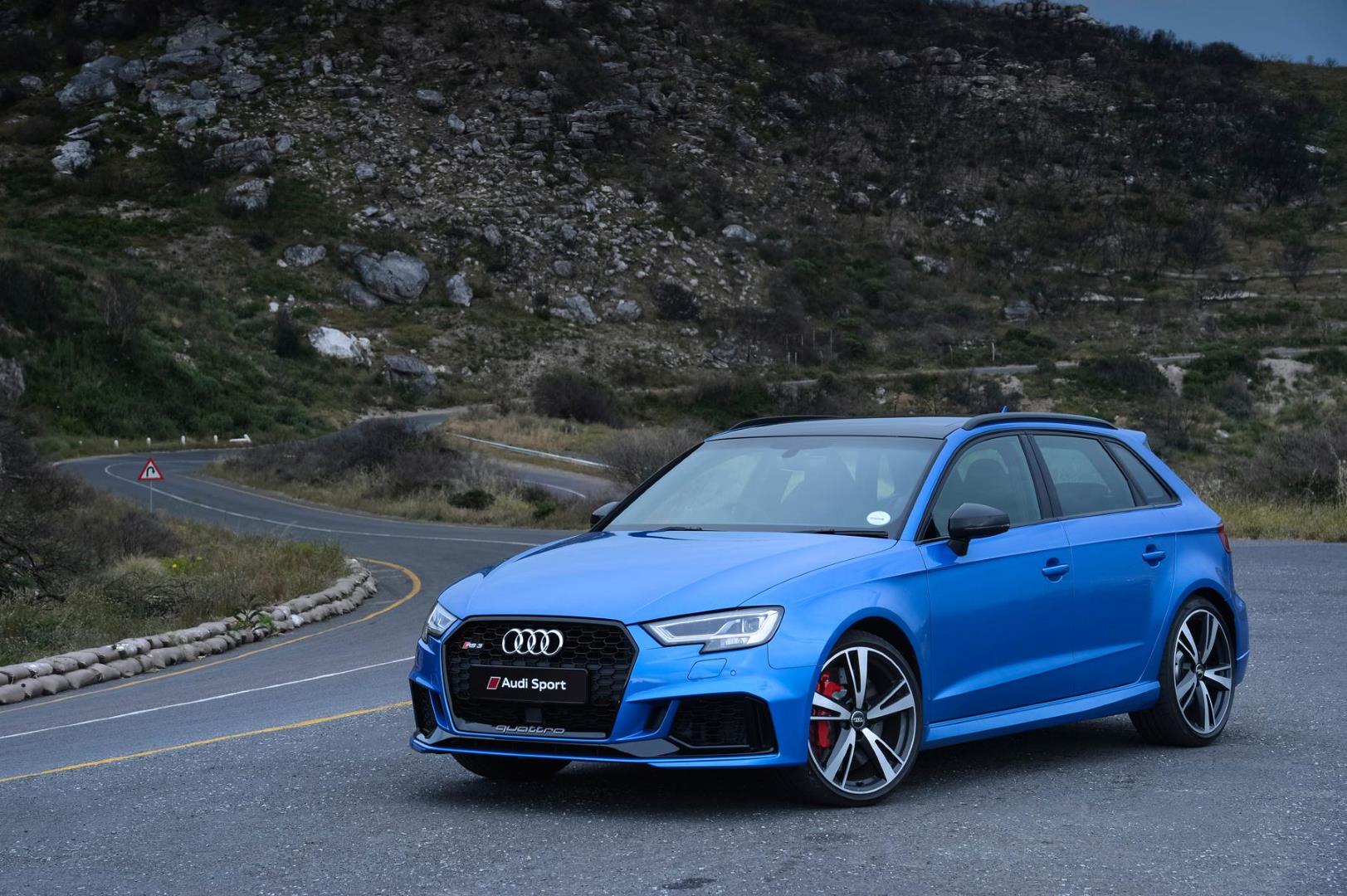
So it proved to be at the Fisantekraal launch venue, where both TT RS and RS 3 acquitted themselves well on the autocross track. Sure, the RS 3 is still noticeably more nose-heavy than the 4-cylinder S3, but this effect is far less pronounced than in the pre-facelift Sportback model. Also note that the RS 3 is now again available in Sportback guise, following the RS 3 Sedan's release a few months ago, as the first car to use the latest 5-cylinder engine.
The TT RS is a completely different animal
We're not just talking about the potent acceleration on offer in the TT RS here, but also about its sporting credentials and handling. It may be based on the same MQB component set as the RS 3, but the TT uses a lot more aluminium in its construction – in fact, most of the front half is made of the lightweight stuff. This translates into less weight and a more favourable weight distribution than the RS 3 can boast, which in turn leads to even sportier handling.
It doesn't exhibit significant traces of either under- or oversteer, and feels surprisingly light on its feet, especially considering the fact that there's a pretty big 5-cylinder lump hanging over the front wheels. Special RS-tuned suspension obviously plays its role as well, giving the TT RS a really agile, easy-to-control character.
It's also more powerful
In its latest form, the 2.5-litre engine delivers 294 kW (up from 270 kW) and 480 Nm, the latter of which is spread between 1 700 r/min and 5 850 r/min. That huge lump of torque obviously makes for tremendous in-gear flexibility and blistering sprint times, with the RS 3 (in either Sedan or Sportback form) hitting 100 km/h from standstill in only 4.1 seconds. The lighter TT RS is even more fleet-footed, with a sprint time only 3.7 seconds – that's quicker than even the more-powerful RS 5!
Maximum speed is limited to 250 km/h for both models, but can be increased to 280 km/h if the buyer ticks the right option box. But it's not just power either, because the 5-cylinder sounds absolutely amazing in both these junior RS-models, and especially so when you press the “noise” button (which activates some flaps in the exhaust to add some volume) in the TT RS. That sound is already reason enough to buy one...
On the road
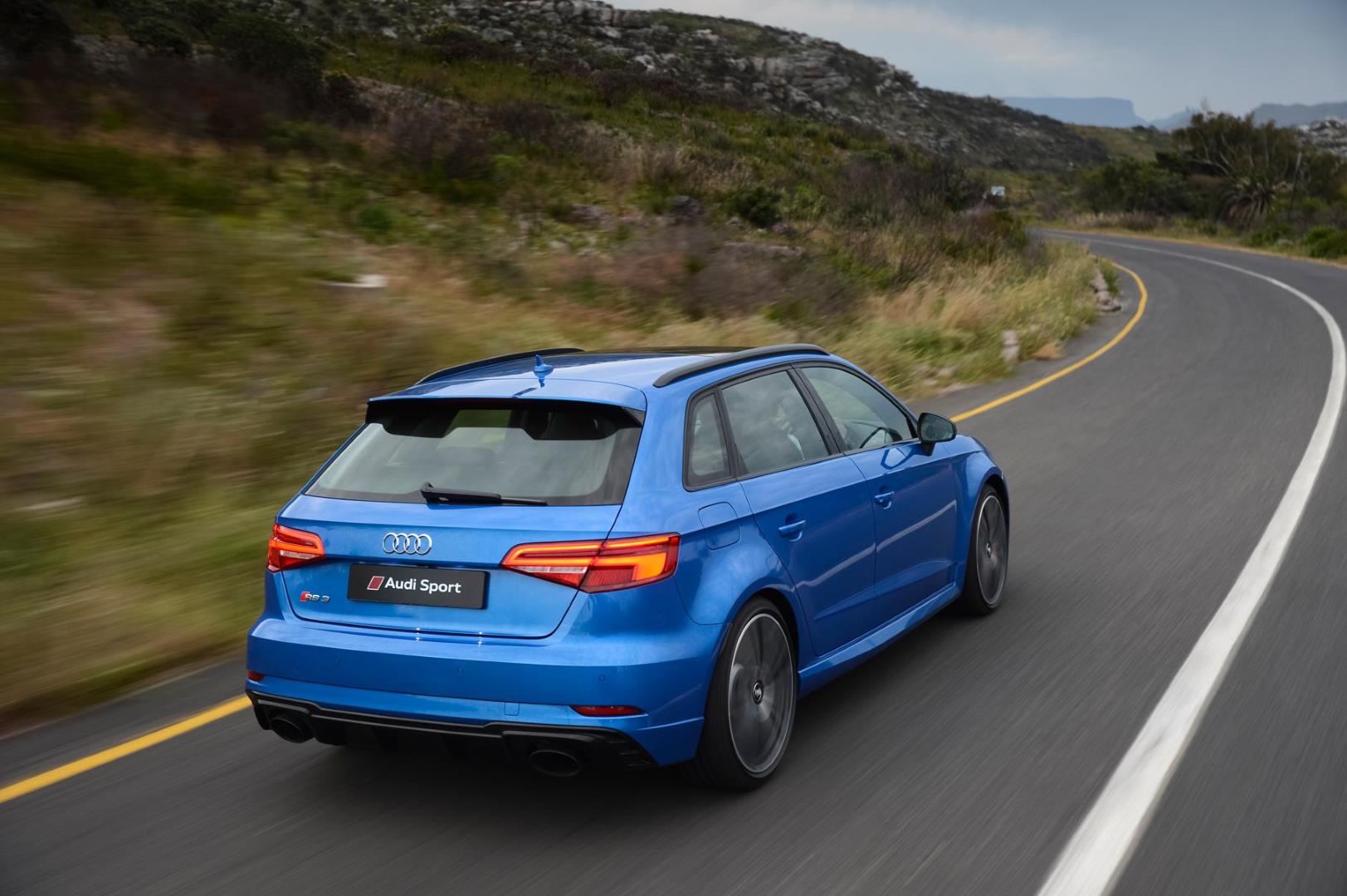
Much like the new RS 5, the RS 3 really shines on the road, rather than on the track. Traction is prodigious, thanks to the all-wheel-drive system, and there's always a surplus of power available to make short work of steep inclines or overtaking opportunities. The 7-speed S-Tronic dual-clutch transmission either slurs smoothly through its ratios or bangs off rapid-fire shifts, depending on the selected drive mode, and the wide power band ensures that there's never any shortage of urge.
When fitted with adaptive dampers, the RS 3's suspension is also nicely compliant, and mid-corner bumps never throw it off-course. All these elements combine help the RS 3 to cover ground faster than you'd believe possible, yet without making any serious demands of the driver.
The TT RS is a somewhat different experience, because it's significantly more hard-core in concept and execution. That firm body control and sports-car handling comes at a price, as the suspension feels somewhat stiff-legged over corrugations – an effect undoubtedly amplified by its 19-inch wheels and ultra-low profile tyres.
Combine that with limited cabin space (the rear seats are really just for show), and it becomes clear that the TT RS will be somewhat compromised as a daily driver. Not that this really matters, as the comfort-inclined will probably be entirely satisfied with a normal TT-S, leaving the hairy-chested little RS for serious drivers only. Either way, it's nice to see such single-minded focus in an Audi.
It comes at a price, though
As befits their prestigious positioning, both the RS 3 and TT RS are fairly well-equipped, although their options lists are as long as their standard specification sheets. 19-inch alloy wheels are standard (with 20-inch items optional), as are special body styling add-ons (including a matte aluminium finish which looks like a million bucks), illuminated door plates, LED lights front and rear, and Nappa leather trim with contrasting stitching.
A strange omission on the RS 3 (which is standard on the TT RS) is Audi's Virtual Cockpit digital dashboard, although it is available as an option. The prices are nonetheless eye-widening, with the RS 3 Sportback retailing for R 895 500 and the TT RS carrying a R 963 000 price tag. Then again, that still makes the TT RS a bargain in the sports car world (and probably the quickest-accelerating car available at that price), while the RS 3 compensates with a huge lot of bang for the bucks.
It's all about that 5-cylinder magic
Leaving the bare performance figures and steep prices out of the equation, the RS 3 and TT RS make a convincing case for themselves on pure charisma. Other challengers might be almost as quick, but none can offer that unique 5-cylinder warble and elastic power delivery.
They might be really rapid, but that exuberant performance is underscored by mature engineering, lending them an impressively integrated feel. Far more than mere small cars with hugely powerful engines, the RS 3 and TT RS are fully-rounded sporting machines, paying tribute to the brand's history and leading the charge into the next realm of performance for their respective classes.
Audi RS 3 Sportback, RS 3 Sedan, TT RS
| Engine: | 2.5-litre TFSI 5-cylinder, turbo |
| Transmission: | 7-speed S-Tronic dual-clutch automatic, all-wheel-drive |
| Outputs: | 294 kW @ 5850 – 7000 r/min, 480 Nm @ 1700 – 5850 r/min |
| Performance: | 0 – 100 km/h in 4.1 seconds (RS 3)/ 3.7 seconds (TT RS), 250 km/h (limited) |
| Price: | R 895 500 (RS 3 Sportback)/ R 925 500 (RS 3 Sedan)/ R 963 000 (TT RS) |