
A breath of fresh air for Kuga
A breath of fresh air for Kuga




By Stuart Johnston
Let’s get the unfortunate history stuff out of the way first. So far, no Ford Kuga fitted with the engines in the current line-up have shown the dreaded “unintended combustion tendencies” that plagued the previous model line-up.
According to Ford, that possibility of the earlier Kugas to run hot and possibly catch fire was restricted to the 1,6-litre petrol turbo model originally introduced on Kuga, and since early 2015, all petrol-fuelled entry-level and mid-line models in the range have been fitted with a redesigned 1,5-litre turbo, which to date has shown no sign of repeating the problem.
These thoughts naturally crossed my mind on the revised Kuga launch this week, as Ford face the difficult task of re-building the Kuga image. Apparently there was serious consideration given to dropping the model all together, but one of the reasons for continuing with the programme, says Ford, was that customers of existing cars who were exposed to the new model indicated they would definitely sign up for the latest model.
A new Kuga face, easier on the eye
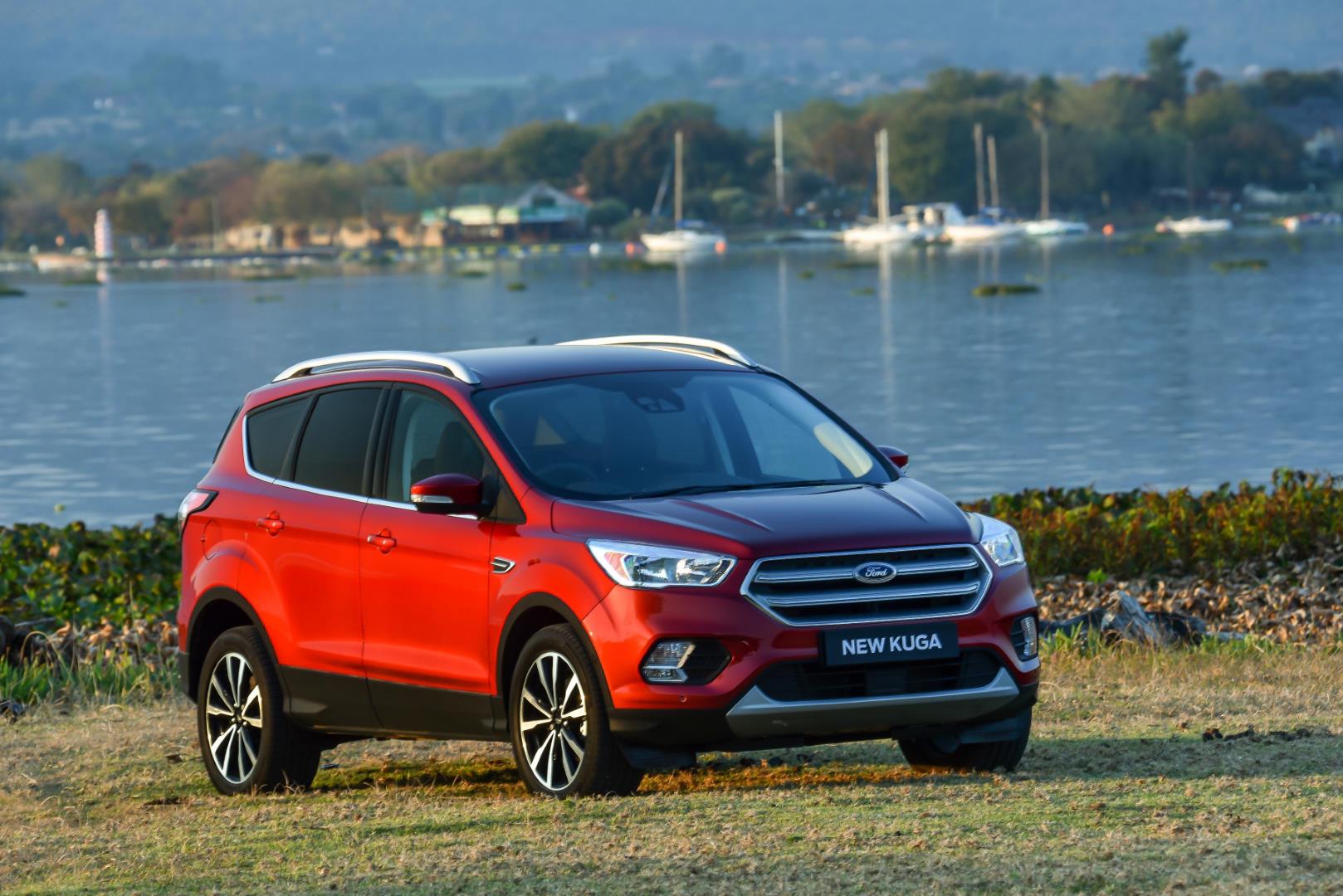
A large number of these new, revised Kugas, with the new large trapezoidal grille, revised headlight and taillight clusters and interior upgrades, were distributed to dealers around the country pre-launch, as courtesy cars, and the feedback was very positive.
On the launch of the face-lift model in the Eastern Cape this week, the first model I drove was the Ford Kuga 1.5 Ecoboost Trend AT , costing R427 900. This model is fitted with a 132 kW version of the 1.5-litre turbo petrol engine previously mentioned. There is a lower-powered version of the engine (110 kW) available, but only on the six-speed manual models, which weren’t available on the launch drive.
The little 1,5-litre turbo works quite hard for its money when pressing on, which we needed to do on occasion in the mountainous area around Hogsback. But the temperature gauge never budged from “normal” and presumably that new more exposed radiator grille opening has made it easier to maintain constant temperatures on the small capacity turbo engine.
Not as light on fuel as the standard test figures indicate
One point needs to be addressed here. Fuel consumption figures for this car are given at about 6,6 litres/100 km. But these figures are in “ideal” conditions. On the launch, driving conservatively, we were averaging 11,5 litres/100 km in the 1.5 turbo model. In a big vehicle like this, it is better to have a larger-capacity engine that doesn’t need constant applications of turbo-boost to keep moving even at moderate pace.
For the rest, the impressions were very favourable, with well-chosen ratios on the six-speed automatic transmission enabling good overtaking acceleration for a large, fairly heavy vehicle.
The interior has been revised, with new upholstery materials and also the introduction of the latest SYNC3 connectivity system, enabling the pairing up of smart phones to the car, and including voice commands. This is standard on the Trend and Titanium models. Optional across the range is Navigation, and at the very reasonable price of just over R5 000. Take note, German manufacturers!
Power Tail Gate
From a practicality point of view the Kuga is good, with a big boot and up to 1 603 litres of load space available with the rear seats folded flat. There is also a hands-free power tailgate-opening option, which many work-a-moms will appreciate as they approach their Kugas after a long day of work, child-care and a stop-off at the local supermarket.
From a driver’s perspective, I found ingress into the seat behind the wheel required a bit of careful contortion to avoid bashing my head on the A-pillar. Once seated I could adjust the seat and wheel perfectly (the Trend model came with a power-adjustable front seat).
The steering feel is very reassuring, and the smooth-road handling provides high levels of grip, even in the Frontwheel-drive model. Later, on the rush to get back to the airport we experienced the All-Wheel -Drive model and found the grip and directional stability very reassuring on slippery surfaces (a light rain meant making out flight even more of a challenge).
Great grip in the AWD model
The All-Wheel –Drive models are available with the 2.0 TDCI diesel engine, which we sampled and the 2.0 EcoBoost petrol engine, which wasn’t available at launch (this produces an impressive 177 kW). These AWD models are on offer in the Trend trim, and in the top-of-the-range Titanium spec, which features 19-inch wheels, and lower profile tyres.
As far as ride and handling goes, one of the shortcomings of the Kuga (and, incidentally) the best-selling smaller EcoSport mini SUV), is that it lacks suspension travel on poor-quality roads. It goes onto the bump-stops far too easily when encountering the kind of potholes likely to punctuate your journey to remote destinations in our country.
Tyre pressures important
In this respect, I tried two examples of the 1.5 EcoBoost Trend model and the one was noticeably more composed than the other. The only explanation for this (they were fitted with the same 50-profile tyres on 18-inch rims) was that the tyre pressures on the one example were much harder than on the second car I tried.
All in all, a pleasant car, the revised Ford Kuga, and let’s hope all the reliability issues are behind this model name, as it is well-priced amidst its strong competition, and offers a good deal of comfort and satisfaction to a driver.
Pricing ranges from R368 800 for the basic-spec 1.5 EcoBoost Ambiente six-speed manual model to R506 900 for the top-of-the-range 2.0 TDCI A/T All-Wheel-Drive model.
*For a detailed interview on the subject of the previous model Kuga recalls and catching fire, read our Q&A with Neale Hill, Ford South Africa’s Director of Sales, Marketing and Service.