
40 years of Porsche V8 engines
40 years of Porsche V8 engines


Porsche’s first V8, for the Porsche 928
The Porsche V8 engine. It all started when Porsche needed a suitable big-capacity smooth and powerful engine to power the first GT car from Porsche, namely the Porsche 928. It was the 3rd model line from Porsche, and instead of a 4 or the flat-6 used in the 911, a V8 was ideal for this new type of Porsche.
Porsche 928 started production in 1977, when the original 928 launched with a 4.5-litre V8. While Porsche had already begun producing a turbo for the 911 flat-6, the 928 was to rely on a bigger V8. The 928’s 4.5-litre engine had a conspicuously-low compression ratio of 8.5:1, which meant it was possible to use regular 91 RON petrol without any issues, which was important to Porsche. However, the power yield was limited, at the lower end of the power extraction possibility. Still, the engine produeced a powerful (in its day) 176 kW, which was sufficient for a top speed of a high 230 km/h. Nominal torque output was 350Nm at 3600 rpm.
This engine may have been big, but was designed to be light and technologically advanced. It pioneered the European manufacture of aluminium-etched cylinder-liners, and the engine constr consisted almost entirely of lightweighht alloy.
The Porsche 928 S followed in 1979, with an increase to 4.7 capacity, and compression ratio upped to 10.0:1. This required the use of super-grade petrol, and power jumped to 221kW, which allowed the 928 S to break the 250 km/h barrier – in those days, this was supercar top speed. A later switch to higher compression and fuel injection saw power at 228kW.
By 1986 Porsche engineers re-designed the V8 to add a catalytic converter, double camshaft per bank, and 4 valves per cylinder. Engine size grew to about 5.0 litres. There is something so right about a 5.0 V8.
In 1987, this 5.0 V8 was introduced in the 928 facelift, which received the new rounded front-end and horizontal split taillights and bigger flat-mounted tailgate spoiler. This was the Porsche 928 S4. Its engine output was 235kW.
The 928 GT model of 2 years later attained 243 kW thanks to sharper valve timing control.
The final production years of 928 culminated in the 928 GTS, distinguished by widened rear arches, 5-curved-spoke Cup alloy wheel, and 5.4-litre V8 producing 250kW.
The V8 engine in the Porsche 928 line had a very specific, thoroughly-growly/enjoyable V8 rumble, whether in the earlier 928, 928 S or 928 S2, or the later 928 S4 cars… distinct, to this day.
The Porsche 928 model line ended production in 1995, and also closed the first era of the Porsche V8 engine.
Cayenne stir
The Cayenne was Porsche’s first SUV when it created a huge stir in the motoring world. It, too, arrived with a 4.5 V8 engine, in a choice of naturally-aspirated 250kW for the Cayenne S, or top-of-the-range twin-turbo V8 Cayenne turbo with 331kW, which catapulted it straight to the top of the performance SUV pile… never before has a production SUV been this fast.
The later Cayenne turbo S saw power reach 383 kiloWatts, making it the 2nd-most powerful production engine Porsche ever built, after the Carrera GT.
The Cayenne facelift in 2007 had a bigger 4.8-litre V8, where the Cayenne S produced 283kW, and the Cayenne turbo putting out 368kW.
Panamera plan
In 2009 the Panamera Gran Turismo fastback was added as Porsche’s additional model line, also equipped with a choice of V8 engines for the upper models.
The outgoing Panamera turbo S model produced 419kW and 800Nm of torque during overboost from its 4.8 V8 biturbo, driven through all 4 wheels and a PDK gearbox, which made it a fastback/sedan/GT car with the performance of a supercar: 0-100 in 3.8 seconds, and a top speed reach of 310km/h.
918 Spyder
The Porsche 918 Spyder was never sold in South Africa, though its eight-cylinder engine is the 3rd generation. Its 4.6-litre un-turbo’d engine was derived directly from the RS Spyder motorsport car. The Porsche 918 Spyder V8 engine produced 447kW at 8700 r/min. That is without the electric boost from the batteries.
“The eight-cylinder V-engine emotionalised the 918 Spyder by its performance capabilities and by its sound. In addition to the ignition sequence, this is attributable first and foremost to what are known as the “top pipes”: the tailpipes terminate at the
upper part of the rear end directly above the engine. No other production vehicle used this solution. The top pipes’ greatest technical benefit is optimal heat rejection, because the hot gases are exhausted via the shortest possible path, and exhaust
gas back pressure remains low.” So now you know – the 918 Spyder’s exhaust outlets on top of the engine are not just for show.
Latest generation V8 engines debut in new Panamera
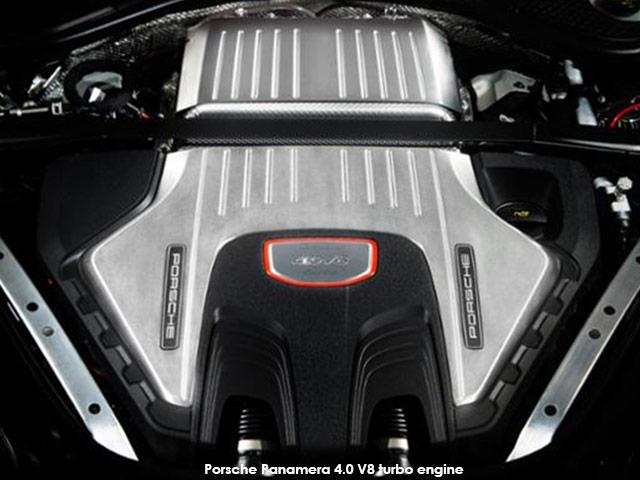
The 918 Spyder engine created a foundation for the new 8-cylinder engine in the recently-revealed new-generation Panamera.
The new Porsche Panamera turbo already produces 404kW and 770Nm… and that from a smaller 4.0 V8 turbo.
The 4th generation Porsche V8 engine has begun.