
2018 Suzuki Jimny – It's finally here!
2018 Suzuki Jimny – It's finally here!



By Lawrence Minnie
It has been 20 years since the last Suzuki Jimny, the SJ, was released to South Africans. The Jimny has enjoyed success for much longer than that, pretty much since the late 70s.
The legacy of the Jimny lineup through the decades has actually played a large role in the development of the new model. We were honoured to attend the official SA launch of this much-anticipated new model.
A legacy fulfilled
The new Jimny has, without a doubt, been one of the most anticipated vehicle launches of 2018. Ever since the first spy pictures hit the web, speculation has been rife about this new model. About 6 months ago, the first official images made the rounds and the fans lost their collective minds.
The Jimny is sporting a completely new look and new tech under the bodywork, and rabid fans and curious new buyers lined up to place their orders. An insider at Suzuki SA confirmed that both initial shipments to SA have already been completely sold out! This has resulted in anyone who did not place a pre-order, finding themselves on a 6-12 month waiting list, such is the demand for this epic little off-roader. That is how far the appeal of the new Jimny has stretched.
But what is about the Jimny that has so many people so excited? To answer that, we have to look at what the Jimny is and what it represents.
What is all the excitement about?
The Jimny is a super-compact 4x4 that has capabilities that far exceed its size. It has been known to put bigger and more powerful purpose-built 4x4s to shame on off-road obstacles and looks surprisingly good doing it. The previous three generations are well-respected and much loved and this has led to its cult-like following. Previous generations have laid the groundwork for the new model, so let’s take a look at some of the advancements that Suzuki have made with the all-new 2018 model.
Exterior Styling
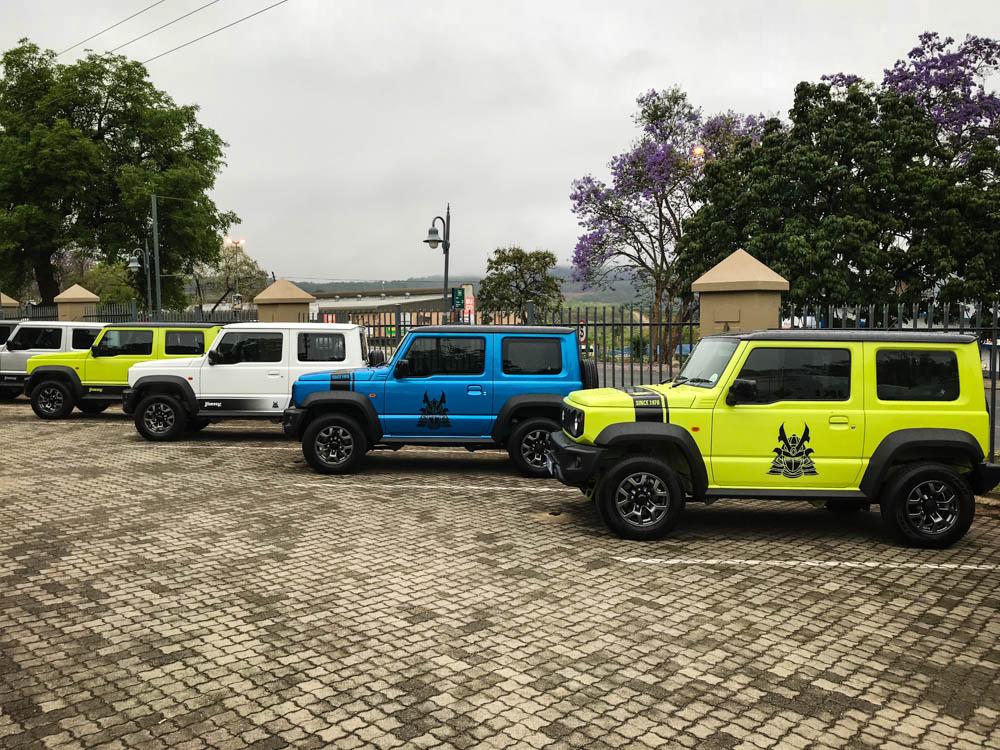
The new style that Suzuki carved out exudes a super cool, tough-as-nails, outdoorsy vibe.
Since the first spy images leaked consumers around the world have been comparing it to the Mercedes Benz G-Wagon, but in fact, it’s the other way around. Many don’t know that the Jimny came out in the early 1970s while the G-wagon only saw production in the late 70s/early 80s, meaning that the inspiration flowed the other way!
It is a very blocky style with a high roofline and big windows all around the cabin, making for excellent eyesight around the vehicle. The new Jimny is a throwback to all the previous generations, and you can see it in the grille, headlamps, indicators, and the clamshell bonnet.
The bumpers (front and rear) have less overhang increasing the angles of the geometry lesson that is the off-road angles for this car. The spare wheel is centrally mounted on the rear door, freeing up space under the car for more clearance. There are other small touches like the wider roof lip that channel water away and make a handy place to attach the myriad of accessories available for the new model. The most prominent exterior styling feature though, has to be the moulded plastic trim panels, wheel-arch flares and bumpers. They add an aggressive look to the pintsize 4x4 that many will find reminiscent of the Jeep Wrangler, and that is not a bad thing!
Interior Trim
The 2018 Suzuki Jimny is available in two trim levels: The GA and GLX, the only difference being the interior trim packages. The GA is very much a bare-bones affair with manual everything; windows, air-con and a small double DIN Alpine head-unit. The GA’s rear seat also does not fold flat into the floor and is carpeted at the rear.
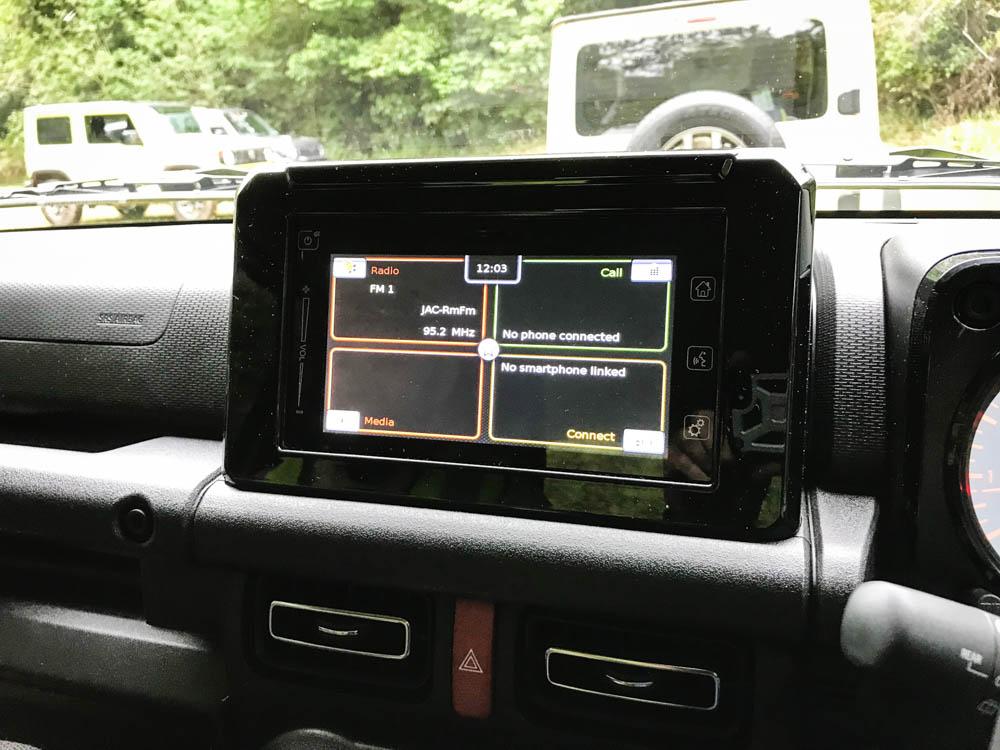
The GLX, though, has a host of amenities. It gets the larger touchscreen infotainment system, auto air-con, better overall trim, and in the rear passenger compartment, the rear seat folds flat into the floor, and is covered at the rear with a patterned, hard plastic covering that is designed to stand up to luggage and equipment that will be loaded in and out of the large back door.
The seats are larger and more supportive than the previous model's, and overall cabin room has been increased, with more available legroom for everyone inside. The dashboard's vertical and horizontal design has a functional purpose: To mimic the horizon to assist the driver off-road. The entire dash is a chunky piece with handholds and textured surfaces. These textured surfaces are split across two of the horizontal planes with the upper having a split line pattern, and the lower resembling the surface of a camera's hand grip.
Although the two spec levels couldn’t be any more different, both vehicles have the exact same underpinnings and drivetrain.
Safety
The new Jimny is considered to be safe, with 3-star NCAP rating, and for a vehicle of this calibre, it's excellent. The Jimny is equipped with two airbags, ABS (anti-lock brakes), BAS (emergency brake assist), Isofix, and ESP (electronic stability control) which keeps you in control of your vehicle.
Engine and Drivetrain
Both models are powered by Suzuki’s new 1.5-litre, naturally-aspirated petrol engine and it has more than enough grunt to take the Jimny virtually anywhere. There are no plans to introduce a turbocharged version and that is just fine by me, as I don’t believe the Jimny needs any more than the 75 kW and 175 Nm that you get from the new engine.
The power from the engine is used incredibly well by the new technology and drive systems that Suzuki has crammed into the Jimny. There is the AllGrip 4x4 system, a stiffer chassis with a new X-member, hill-hold control and hill-descent control. Suzuki listened to their fans and did away with the previous model's push-button 4WD selector buttons, and replaced them with a purposeful manual lever that engages the 2H, 4H and 4L.
Drivers have a choice between the 5-speed manual or a 4-speed automatic with overdrive.
Both work well in the Jimny's natural environment off-road, but it was the tar sections of our launch route that would ultimately be the deciding factor.
The Drive
Suzuki tried very hard to keep us in the Jimny’s natural habitat for as long as possible. We spent a great deal of time off-road trying out a number of new features and generally experiencing the new capabilities. The Jimny is as agile as a mountain goat across all types of terrain and the power delivery and drive through the AllGrip system was near perfect.
Things, however, changed a bit once we hit the long tar road back to town and soon the Jimny's on-road manners became evident.
The new Jimny’s tar manners are astoundingly better than the previous generation but are still not 100% up to scratch. The automatic gearbox was left wanting on more than one occasion and was constantly hunting for gears at 120km/h and then, when applying some accelerator input, the transmission would drop down two gears and the revs would climb alarmingly. There was quite a bit of wind noise but that’s to be expected from the near-vertical windscreen and A-pillars.
There is still quite a lot of body roll but the new Jimny does feel so much more planted in the bends than its predecessor did. The 5-speed manual was the pick for road driving and at 120 – 130km/h was very comfortable. The auto excelled at the off-road terrain though, and was the right pick to do the dirty work...
Verdict
The new Jimny is an incredible little car with amazing capabilities, but in truth it's not that great for daily road driving. I would say that it is in almost exactly the same category as the Toyota 86: An absolutely amazing machine for what it does best, but not very practical for day-to-day living. These types of vehicles make excellent secondary cars for that bit of weekend fun and will give you many hours of joy, and they can be daily driven but should be best used where they belong: In the Jimny's case, off the road.
Models and Pricing
Suzuki Jimny GA - R 264 900
Suzuki Jimny GLX MT - R 299 900
Suzuki Jimny GLX AT - R 319 900