A closer look at Triumph’s new Tiger 1200
A closer look at Triumph’s new Tiger 1200


By Réhann Coetzee
After attending the launch of Triumph’s 2018 model line-up a few weeks ago, I was way more impressed with the Tiger 1200 than I expected to be.
I couldn’t help myself when I described the new Tiger 1200: “Triumph has now taken the dual-purpose bike to the next level. The Tiger’s engine is still the most tractable of the big duallies – from idling speed upwards – although not the most powerful. The Tiger 1200 really feels like the iron fist in a velvet glove.”
No longer called the Tiger Explorer, the Tiger 1200 has once again evolved in refinement and its offering. The jump from the first-generation Explorer (of 2012) to the second-generation version (in 2016) was huge. It was smoother, even more responsive and it had more ground clearance. It got electronic suspension adjustment and rider modes. The seating was more comfortable and the redesigned windscreen was electrically adjustable.
The evolution to the 2018 model, now just called Tiger 1200, has been as surprising, because the 2016 bike was an excellent vehicle. Apparently Triumph has made more than 100 improvements – and that is even harder to believe. But after riding it, you are left with no doubt about this being an even better bike than the 2016 model.
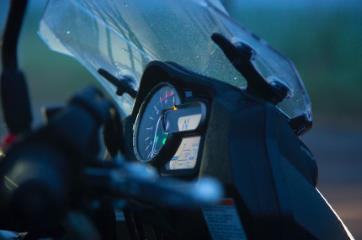
Apart from the new LED headlights, indicators and fog lights, the first apparent change has been to the instrument panel and switchgear. Like all new bikes, the Tiger 1200 gets a TFT instrument cluster. The switchgear is all new too and where the 2012 and 2016 models had really bulky switch boxes on the handlebars, the 2018 model’s is smaller, neater and much clearer to operate. The switches are also backlit and I was amazed at how big a difference that made in the dark.
The various adjustments are now much more intuitive. And there are many things that can be adjusted. Other than the expected rider modes, ABS and traction control, you can also choose between display styles. The screen can adjust automatically to ambient light conditions, but that can also be overridden.
Rider modes can be refined to your specific taste or requirement, but there is also a “Rider” riding mode. I chose that for my daily riding style. I set the engine mapping and traction control to sport, because the Triumph traction control can be very intrusive. Even if you just ride over a manhole cover with slightly too much throttle, the nanny-like traction control wants to hold you gently and wrap you in cotton wool. But this can be irritating too, especially if this happens when you’re pulling away from a traffic light and want to get in front of traffic for safety.
When you venture off tar, you can choose between two modes for this: Off Road and Off Road Pro. In the ordinary Off Road setting, ABS is switched off for the rear wheel, but not the front. In Off Road Pro, the traction control and ABS are switched off totally.
The quick-shifter (called the Triumph Shift Assist) doesn’t have the sexy auto-blip bark that BMW’s system has, but it is smooth and works really well. I’m still of the opinion that this is the best quick-shifter I have experienced so far. I think it won’t be long before we cannot get along without this luxury – just like electric windows in a car.
Like the new BMWs and KTMs, the Tiger 1200 now has keyless ignition. I realise that this is the way of the future, but I’m not too fond of this. Although, I do appreciate the electric steering lock and the fact that you can immobilise the bike with the remote or keyless key or whatever it is called. I put the test bike’s on a lanyard with my gate remote and managed not to lose it, so I suppose it can work.
Triumph says the Tiger 1200 is 11kg lighter than its predecessor. Apart from its not-great ground clearance, the biggest criticism of the Explorer has been that it is really heavy. The 2012 model’s wet weight was 259kg. Only the truly porky Honda Cross Tourer was heavier than that. But, maybe because I’m not a lightweight either, the weight of the Explorer has not really bothered me. Similarly, I cannot really say that I feel the 11kg lower weight now either.
The Brembo brakes are worth a mention, though. The difference they make is noticed from the very first time you apply the brakes when you start it. The brakes are sharp, very effective and certainly inspire confidence.
With the greatly enhanced ergonomics, the Tiger 1200 also has adaptive cornering lighting. This is done by two sets of LED lights that switch on as you corner, illuminating the road surface where the headlights won’t because of the angle of the bike. The first time that these lights come on can be a little disconcerting, because it feels like a car is trying to pass you when you see the effect of these lights.
The speed control works as well as on the older models, but is also easier to understand, operate and adjust. Even in the dark.
Other electronic trickery that is not immediately apparent includes what Triumph calls fully integrated management systems controlled by an Inertial Measurement Unit (IMU), integrated braking system (developed with Continental), optimised cornering ABS and traction control, hill-hold, ride-by-wire throttle, and the riding modes to configure the motorcycle to suit its terrain at the press of a button.
The quick-shifter, adaptive cornering lighting, fog lights and Arrow silencer are standard on the XCa. Sadly, tyre-pressure monitoring is not standard anymore, but can be ordered as one of more than 50 options. The XCa also has heated seats for the vicious winter mornings.
As I mentioned in the first article on the Tiger 1200, Triumph SA will not be importing the more tar-focused XR line-up of the Tiger 1200 – only the XC and XCa.
After having spent a week on the Tiger 1200 (in Matt Marine), I’m not quite as star-struck as I was after the launch. But I see no reason to change the tone of the first article. This is a stunning bike and I would love to park one in my garage.
Technically speaking: Triumph Tiger 1200 XCa
Engine: 1 215cc, parallel 3-cylinder, DOHC, four valves per cylinder, liquid cooled
Power: 104kW @ 9 350rpm / 122Nm @ 7 600rpm
Gears: 6 speed, shaft
Fuel tank: 20 litres
Seat height: 835-855mm
Tyres: 120/70/19 front, 170/60/17 rear
Brakes: 4-piston 305mm double disks (front); 2-piston 282mm single disk (rear)
Dry weight: 248kg
Price: R248 000