Falcons Rest
The 90s were a wild west time period wherein motorcycle manufacturers engaged in an all-out war to be the fastest. The title of fastest production motorcycle was a holy grail that changed hands regularly until the Suzuki Hayabusa arrived. The "Peregrine Falcon" laid waste to the competition and held the title of quickest in the land until the title was wrested from them. By that time Suzuki was not phased as they had made their point.
Related: Suzuki DL650 (2022) Review
The new breed of superbike was indeed quick but by all accounts nearly impossible to ride by all but the bravest. The Hayabusa had set the bar for comfort and speed that was manageable and easy to use. Now in its third generation the 2022 Suzuki Hayabusa builds on the legacy and delivers a superb riding experience, Let's take a closer look at this attack falcon from the land of the rising sun.

Styling
At first glance, it would seem that not much has changed with regard to the rounded off bulbous styling of the Hayabusa. Closer inspection however reveals a few new styling tweaks. The new machine seems to be cleaner and crisper and less fat than the outgoing model and this is down to small changes such as integrated turn signals, and tank panels bossed with a feather pattern resembling those of its namesake's neck, unobtrusive chrome edging and a much cleaner kanji character design. The Kanji incidentally is the Japanese lettering for Peregrine Falcon in case you didn't know.
The Hayabusa is instantly recognisable, looking like it's traveling 400km/h while it's standing still, there can be no mistaking it for anything other than what it is. Locally the 'Busa is available in 3 attractive colours, Glass Sparkle Black, Metallic Matte Sword Silver, and Pearl Brilliant White but it must be said that the White by far looks the best of the lot. Admittedly we are not fans of the massive twin exit "Bazooka" style tailpipes, but as with everything these days, they are required for emissions controls, but this is easily remedied with an aftermarket slip-on.

Tech
The most exciting addition to the 2022 machine is the host of new tech. The new 'Busa is now equipped with SDMS-a (Suzuki Drive Mode Selector Alpha) which gives three pre-set and three customisable riding modes. These offer variable power modes, traction control settings, anti-wheelie control, engine braking control, and an up and down quick shifter, you also get cornering ABS, hill-cold control, and cruise control, as well as Launch Control, a nifty feature indeed!
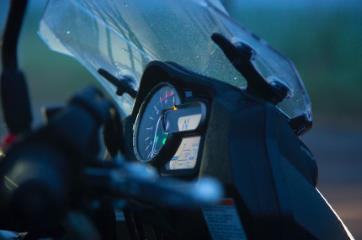
The new dash is also a mix of the old-style analog tach, speedometer, and temp / fuel gauge with a new TFT screen interface that gives you the rest of the readouts. The addition of this new tech makes riding and enjoying the Hayabusa even better than before.

Engine and drivetrain
Some enthusiasts were disappointed to find out that the new 'Busa would not be turbo or supercharged but would rather retain its inline 4 cylinder NA power unit and would in fact make less power than it previously did, and yes the new engine had been tuned to make less power up top but in fact, had been fettled to make better torque and power in the mid-range where most sane riders tend to operate. The 2022 machine now pumps out 140kW and 150Nm from its 1340cc engine and is at its liveliest between 3000rpm to 7500rpm.
The front and rear suspension is from KYB and is supple enough to soak up the worst of the bumps while being sprung enough to make attacking corners less daunting and more confidence-inspiring. A point to note though is that until the brakes get up to some sort of temperature they feel wooden and are not progressive, once they have some heat in them though, you can really get on with things knowing that the 'Busa will stop on a penny.

Let's ride
As one gets older the idea of climbing onto a sportbike for a long ride is less appealing. Compressed vertebrae, aching wrists, and sore knees are the order of the day on a sportbike. Not so with the 'Busa!. It is by no means a day at the spa but for some reason, the rider triangle here seems to put less strain on the wrists and lower back. Climbing onboard gives one the impression of strapping oneself to a small rocket, Wile E Coyote style, a short push of the start button and the engine snaps to life with a satisfying burble.
Riding the Hayabusa is something of a head trip, you've gently and only incrementally give the throttle a twist, and you're cruising along the freeway, idly watching the scenery ahead of you, and you just glance down at the display to find that you are doing twice the speed limit, Unintentionally off course! The 'Busa is just so easy to ride, no song and dance, no fireworks, just easy and manageable performance on tap. It's a given that the 'Busa is absolutely brilliant at straight lines but where it truly impresses is in the twisties. It does require some work to get it through corners as It's not exactly flickable at 264 kg's, you won't be dragging knee ala Marquez, but it will come back up and over with a little bit of effort and does turn into an absolute gem to ride Sport touring style.

Pros and Cons
- New rider assistance technology
- Still incredibly fast
- Comfortable rider position
- Twin exit exhaust system hampers looks and performance
- Cold brakes feel wooden

Model and Pricing
Suzuki GSXR 1300 Hayabusa - R 335 000

Verdict
Over 20 years have still not dampened the spirit of the Hayabusa, it is still phenomenally fast and just as comfortable to ride. The addition of the new rider-focused tech and engineering tweaks have just cemented this as the best amongst superbikes. Yes, it is not the fastest anymore but in all honestly who in their right mind is riding around at 300km/h? The 'Busa has usable torque and speed in the sweet spot where most sane people ride and that is what makes it truly the best and why so many still consider this the apex predator.