Buzzing around town
Twenty-five years ago, Honda first released the Hornet, a compact sporty naked that took city riding to the next level. A few decades later and the Hornet is back with the same dynamics that made the original so desirable. The new 2023 Hornet gets a brand new engine shared with the new TransAlp, pointy styling, and riding dynamics that make the city commute an adventure every time.
Related: Honda XL750 Transalp (2023) Review
With an upright riding position and a torquey engine that burbles satisfyingly, we hit the streets to see if the Hornet can still deliver on its promise of a sporty ride, compact handling, and traffic-beating dynamics.

Styling
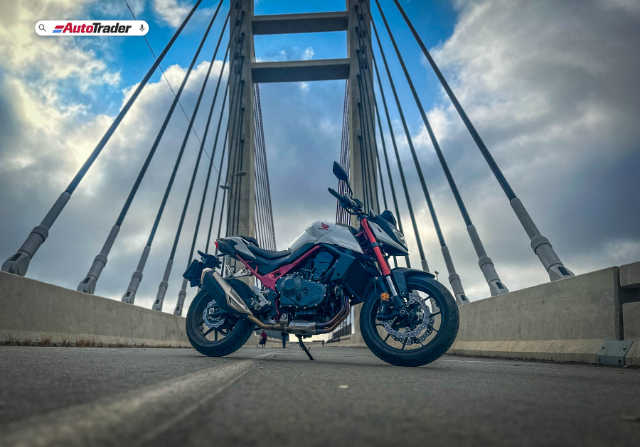
At first glance the Hornet looks aggressive, its pointy street styling lets you know this bike means business. Honda says that the fuel tank design takes inspiration from the wing of a Hornet. The seat is low so you feel like you are sitting in rather than on the bike and comes in at 795mm height so even short folk can flat foot it.
The Hornet is sold in SA in two colour variations, Graphite Matte Goldfinch Yellow with black accents and our test units spec, Pearl Glare White with a Metallic Red Flame frame and anodised red forks and in all honestly it looks way better in the white arrangement.
The Hornet gets LED lighting all around but we're still not completely sold on the headlight arrangement. Although our test unit was a base model, Honda does offer a number of accessory packs to spice things up, A Touring pack offers a set of panniers, seat, and tank bags, a Sport pack offers a quick-shifter, fly screen, rear seat cowl and rider footpegs and the Style pack gets you handlebar-end weights, a handlebar upper clamp holder, a tank pad, wheel pinstripes, and frame sliders. These packs are an extra cost so having a chat with your Honda dealer may be in order.

Tech and Features
Perched atop the front cowl is a 5" TFT screen through which you will interface with the bike's vitals, these being the rider modes, fuel consumption figures, speedo etc. The screen is well-lit and easy to read in different lighting conditions although the handlebar controls are a bit fiddly at first.
The three rider modes on offer are Standard, Sport, Rain, and a USER-specified setting wherein the rider can customise the parameters to their liking. Riders can tweak the 3-level Honda Selectable Torque Control (HSTC), and Wheelie Control with 3-level Engine Power and Engine Braking adjustment to get the perfect ride.
Honda has also integrated smartphone voice control into the system (compatible with Android and USB devices)although a helmet-mounted headset is needed, as the smartphone connects to the dash via Bluetooth (no word on Apple compatibility)

Engine and Drivetrain
As mentioned earlier, the Hornet is powered by the shared 755cc eight-valve parallel twin-cylinder petrol engine that is found in the TransAlp. The engine makes 67.5kW and 75Nm and does so with a satisfying burble at idle but does begin to buzz, just like its namesake, at higher revs.
Power from the 6-speed slipper clutch is transferred to the 17" rear wheel via chain drive and because this machine weighs in at a mere 190kg, the suspension does need to be sorted. The suspension comes in the form of non-adjustable Showa 41mm SFF-BP™ upside-down forks and an adjustable rear shock operating through Pro-Link monoshock featuring 150mm of travel and five-stage preload adjustment.
The Hornet is able to stop at the drop of a hat due to the dual 296mm rotors with four-piston calipers up front and a single 240mm disc and single-piston caliper at the rear.

Let's ride!
In one short word, FUN! The Hornet is fantastic to pilot around town and slices through traffic like nobody's business. Although provision is made for pillions this machine is not made for carrying passengers as a clamp on the brakes will result in bruised nether regions as the passenger weight shifts directly onto the rider.
Riding alone, however, is a treat, as the bike is nimble and agile through corners and has a beautifully smooth throttle roll-on from the ride-by-wire system making this quite a dynamic ride in the city.
Comfort levels do plummet though when taking on a longer route as rider fatigue increases the longer one stays out exposed to the buffeting wind on long open roads, this one is definitely meant for city dwellers who are commuting. If one takes a look a fuel consumption it is plain to see that the Hornet is made for zipping through town as our test unit did not even need to refilled, returning a mere 4.0l/100km meaning that we were on track for 345km on the 15l tank.
The only drawback is that the Hornet felt less refined and not as well put together as some of its segment contemporaries and was missing a few features that competitors have as standard and when factoring in the price it gave us pause for contemplation.

Pros and Cons
- Beautiful design
- Easy-to-use tech
- Balanced engine (Power vs Torque)
- Light and agile
- Fuel efficient
- Lacks refinement
- Base model lacks features that other competitors have as standard

Model and Pricing
| Honda CB750 Hornet | R 179 999 |
* Pricing for add-on packs available from Honda Dealers on request
Verdict
The Hornet is a cracking ride and lives up to the nameplate quite well. The Hornet is made to buzz the city and deals with that incredibly well. It does have its work cut out for it in the segment as competitors are offering standard features for less money and have a more refined ride. I would say that this one is definitely for the fans of the wing that are looking add a spicy commuter to their garages.