
Learning to Ride - How to become a biker chick
Learning to Ride - How to become a biker chick. Part 1


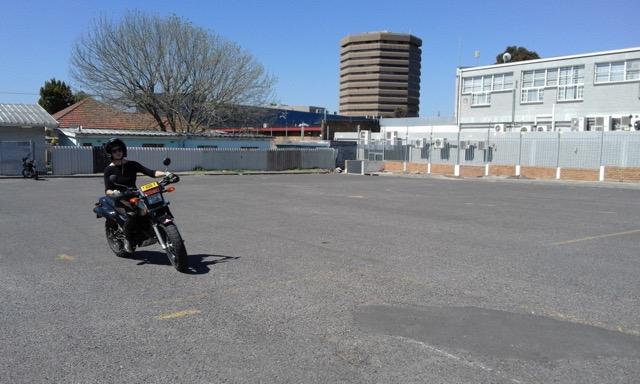

I’m not afraid of many things. The dark? Here, let me switch off those lights. The dentist? I floss regularly, have good tooth-genes and I quite enjoy the laughing gas. A Rain Spider the size of my hand? I’ll catch it with some Tupperware, and set it free outside. Heights are an altogether different story: The cable car trip up Table Mountain leaves me in a film of cold sweat. Things with four wheels and an engine? As long as there are enough airbags I am quite okay with tearing around Killarney racetrack or ‘giving it horns’ on deserted roads. But things with TWO wheels and an engine? Even though I have fantasized about riding a black speed bike with a black helmet, in sexy black leathers, it never quite happened for me. At first my mother preached about the dangers, then my dad, then my brother… and after driving past a dismembered biker on the side of the road recently, I haven’t had much desire in becoming a motorcyclist. Still, somewhere in the back of my mind something was tickling me to at least give it a try. I don’t have to become a full-fledged biker chick and join a gang - maybe I can just learn how to ride, get my license, and ride on the odd occasion. And so my journey begins.
Finding a patient teacher
With no background of bike riding whatsoever, I set off to find someone who’d be willing to teach a complete biking greenie, like me. A good female friend (and motorcyclist extraordinaire) gave me the number of someone who teaches motorcycle virgins to ride from scratch. Billy de Beer, owner of BikerSafe Academy in Cape Town, is keen to help. “Can you ride a bicycle?” he asks. “Sure”, I say, “But the last time I rode one was in Grade 6”. “Do you have decent balance?” he asks. I think for a moment. Then I remember that I do handstand push-ups at Crossfit class. “Sure, I have balance”, I say. And as Saturday rolls on, I drive to Bellville in my luxurious test car, a new Volvo XC90, kitted out in a comfy pair of pants, boots, and a T-Shirt. As we’d only be riding around a large, safe enclosed area, I don’t need the full-on biking kit yet.
Because you’re worth it
It’s hot and sunny in Bellville, and Billy’s colleague André, is already supervising some inexperienced bikers as they ride around the “practice track”. I am definitely one of the older folks, and the only member of the female species. My two co-greenies are young lads, one is sixteen and the other in his early twenties. The sixteen year-old can already ride a little, and the other one is also more familiar with the experience than I. Then Billy arrives. “What is your life worth?” he asks. “If you had to put a price on your life, how much would it be?” Tough question - I’d never given it much thought. But if I had to die or be seriously injured, how much money would my family need for my time spent in ICU, or a funeral? Then there’d have to be a full-time nanny to take care of the kids, as Mom is six-feet-under. Not a happy thought.
The point Billy was trying to make, is that your life is at least worth the price of a decent helmet. It is your most important piece of life-saving kit. As Billy says, they can sew your body back together, but if you seriously injure your head, you are done for.
So, when buying a helmet, what should you look for? Start looking at helmets of R5000 upwards, with a Department of Transportation (DOT) sticker. This means it meets basic impact standards. Proper fit is super important, if it’s too tight you’ll get a headache and if it’s too loose it will shift and be utterly useless. Trendy open-faced helmets are a no-no, and so is riding around without fastening the strap. And if your helmet has suffered a hard knock or blow, it will probably need to be replaced! Buying a second hand helmet is not a great idea either – you never know its true history. And a helmet should most definitely not be black! The reason? “I don’t know how I managed to hit him, Officer, he came out of nowhere.” Being invisible is not cool when you’re a sitting duck on a motorcycle. Visibility is your responsibility.
I immediately decided I’d look for one in shocking pink or acid yellow. Then there’s plenty other stuff you’ll need if you want to keep the skin on your limbs. But let’s get to the learning how to ride part first.
Mental hygiene & the learning process
All three of us first had to learn how to ride a scooter properly. The boys had no problem, but my legs, a bit long for the scooter, seemed to have a mind of their own. Every time I turned, they seemed to want to counter me leaning into the curve, and send me in the opposite direction. From the muffled interior of my crash helmet, I could hear Billy shouting, “Maak toe jou bene!” As we were continuously riding in anti-clockwise circles, something in my mind must have gotten stuck. When Billy put orange cones down for us to ride through, slalom-style, I somehow couldn’t turn right and kept driving over the cones. Eventually my brain snapped out of its one-directional rut, and I managed to ride that scooter like a freshly licensed Grade 10 pupil. Billy and André assured me I’d fare better on the bike, as my legs would have more purpose than on the scooter.
After a break and more lessons in road safety, we were on the bikes. Because I needed a bit more TLC (tuition & loving care) than the boys, Billy gave them their lesson in operating the clutch, getting the bike into gear, and opening the throttle, while standing still. Then they progressed to riding without assistance, and I got onto the stationary motorcycle. I really had to keep my head together. It’s not at ALL like driving a car, except that you have to activate the clutch if you want to change gears. After some blood, sweat and tears, I progressed to riding the Yamaha TW 200, and I clung to that bike like an orphaned lemur to a branch, trying to form new neural pathways in my 37-year old brain. Billy corrected my posture and my throttle-wrist quite a few times. You can’t just sit on a bike any way you like. You have to position yourself properly, sit close to the engine, relax your shoulders and elbows, and just be loose and normal. You also have to look where you are going, but not on the ground - you have to lift your head and look in the direction of where you want to travel. Sounds like common sense, doesn’t it! But if you’re trying to avoid a cone and you look at it, you ride over it. Don’t ask me how that works, but somehow your brain and your eyes seem to make your front wheel aim at whatever it is you are trying to miss.
After an hour or so, my behind was stiff from nervously squeezing the motorcycle with my thighs. I wasn’t excelling at this, like I thought I would. But after continuously repeating the necessary steps, I started to get the hang of it. And as I felt the wind on my cheeks as I went around the cornering cones, I really started to enjoy myself. It was still taking a lot of thought just to change gears, and to pull away from standstill without “throwing the clutch away”, in Billy’s words, or stalling. At one point I thought I was closing the throttle, but instead I opened it, and went flying, going completely blank as I was doing it, unable to stop. I slammed on the brakes, embarrassed. I had to giggle at myself as the boys could be seen chuckling, from a distance. I wished someone had caught it on video, because it would have gone viral on the Internet. Apparently not everyone makes it past the scooter-level, so I was quite satisfied with my performance, although it was a little wobbly.
Lessons learned
After the five-hour lesson, I could pull away from standstill, change gears, use the rear brake properly, use the front brake and corner without injuring myself. We also listened to Billy’s informal (and unnerving) lecture about the dangers on the road and how to protect ourselves. Nobody gives a rat’s rear-end about motorcyclists, so we have to be more vigilant than a superhero at all times. Whether it’s a blob of slippery diesel on a mountain pass or a distracted mom in a Land Rover Discovery Sport, you’ve got to have your wits about you. You will also learn the tell-tale signs of when people in cars are about to do something potentially life-threatening, like making a U-turn or opening a door.
One of Billy’s most important points included giving yourself enough time, and space, to stop. The more time you give yourself, the lower the risk. Driving too fast and braking too late is one of the biggest causes of bikers getting injured. And don’t use the public road as a racetrack! As Billy says, “No matter what you ride, you’re only as good as how well you can stop. If you’ve got five metres to stop and it takes you six, you’re gone!” That’s why he encourages bikers to sensibly use the rear brake in conjunction with the front to get to a good stopping distance, before coming to a complete stop by using the front brake. But slamming on the rear brake won’t do you any good either as it can cause the wheels to lock, so gently does it. Practise your braking, see how long it takes you to get to a certain spot. But for best results, consult a pro, like Billy*. At BikerSafe Motorcycle Academy you are taught everything you need to know to become a responsible, well-rounded biker (if there is such a thing)!
But for all the safety tips and tricks, you’ll have to take the course. And read the second instalment of my ‘Learning to Ride’ story, as I still plan on taking some more lessons, writing my learner’s, getting the correct gear, and getting my license. I also plan to spend an evening with a notorious biker gang.